Sharing their stories to help others with similar feelings
At Easter, after struggling with depression and anxiety for years, Ashley Metzger felt it was time to share her struggle with others in the congregation of her church.
After that, others asked her to share her story, with hope that it would help others who have, or have had, the same feelings of sadness and hopelessness.
On Monday, Metzger was joined by others affected by anxiety, depression and thoughts of suicide at a community event.
Her church, CenterPointe Church, hosted that event, to allow people of all ages to hear those stories, and to get the word out that those who have those feelings that help is available and all that they need to do is ask for it.
At CenterPointe’s Easter service, Pastor Rod Caswell gave members of the congregation an opportunity to give testimonies.
“I was sitting there, and this voice in my head was saying, ‘Go up there and talk, go up there and talk,’” Metzger said.
“So, I went up there and talked for like two minutes, and that’s how it all exploded,” she said. “Churches asked me to talk and schools got a hold of me.”
Then, Metzger was asked about speaking at an event for the community, and she was more than willing to do so.
“I have suffered from anxiety and depression, and I noticed that nobody talks about it … and I wanted them to be able to talk about it and open up,” she said.
She currently has a group on Facebook, “Bring It All to the Table,” a private group that has 1,000 members. Through that group, women are able to share their feelings and discuss them with others.
“Now, we’re wanting to get a teenage group and a men’s group,” Metzger said.
The idea of the community gathering for this topic came about before the recent suicides of two teens.
“I wish I could have gotten a hold of those kids before, but I didn’t know (what they were experiencing),” Metzger said.
Suicides like those happen, she said, “Because people think they’re alone and that there is no help … and there is help.
“We have resources here,” she said.
Some of those resources – Community Resource Center, One Hope United and T.E.C.S. Counseling – had representatives present at Monday’s gathering to explain the help they can offer.
Metzger said during her presentation on Monday that she began experiencing depression and anxiety began when she was 17, when the boy she was dating was killed in an accident.
“I was down, sad, depressed and lonely at that point in my life,” Metzger said. “I was having panic attacks all of the time.
“I didn’t want to go to school. I just laid in my mom’s bed and cried constantly,” she said.
Metzger also talked about other generations of her family experiencing those feelings, including some who had committed suicide.
With medication, Metzger said, she began to feel better.
Those feeling returned after the birth of her son and then again after the birth of her daughter eight years later.
“I had no hope. I was in despair and I was lost,” she said.
During the third trimester of the pregnancy with her daughter, “I remember going in my bedroom and lying on the floor and praying to God, ‘Please make this stop.’
“I had the perfect life – I had a new car, I had a new house, I had a healthy family,” she said. “I had the picture-perfect Facebook family.”
She told about walking with her son on the overpass of a highway. “I remember thinking, if I could just throw myself over this bridge, I will never have to deal with this again.
“I had a suicidal plan – I was going to take a lot of pills,” Metzger said.
“I truly didn’t want to die – I just wanted the pain to stop,” she said.
Metzger told of how she has undergone in-patient treatment to deal with her anxiety and depression, and said that she “prayed constantly, I went to church and I worshipped constantly, and I began to see the light.”
Her message to others experiencing similar feelings was, “No matter how bad things are right now … I promise it won’t last forever. I promise you’re going to be OK – I’m proof of it.
“A single bit of help is still a very powerful thing, and there is help available,” she said.
“With the right help, medication, therapy and support, God can do anything,” Metzger said. “Keep going – you are worthy and strong.”
Also telling her story of anxiety and depression was Amanda Kamplain.
“I can’t stand up here and show you any scars, because I don’t have any – all of my scars are inside,” Kamplain said.
“But what I can tell you is that I know what it’s like to feel so numb that you just want to feel something.
“You don’t feel pain, you don’t feel happiness – you just don’t feel at all,” she said.
“Most of you guys know me as the bubbly, happy, energetic math teacher,” Kamplain said. “I haven’t always been that way.”
She shared three events in her life that sent her into periods of depression, anxiety and sadness.
The first was in high school, when her parents made her break up with her boyfriend. “I thought my life was over,” she said.
“I remember sitting on the bathroom floor, a razor in my hand – I was ready to go,” she said. “I don’t think it was so much that I wanted to end my life; I just wanted to feel again, I wanted to feel alive.”
The second event was while she was in college. When she began feeling depressed, she spoke with a professor who had spoken openly about having such feelings.
After that, she was working on a class project when police officers knocked on her door, to check on her.
“That was my wakeup call,” Kamplain said.
She then addressed her issue with medication, deciding to wean herself off of those in 2013, doing so by focusing on fitness.
“That’s my outlet,” she said.
But, Kamplain said, those feeling returned – as was the case with Metzger – after the birth of a child.
“I remember a week (after son was born), I felt no connection (with him), no bond. I would cry all of the time.”
This time, she said, “I took a holistic approach.”
“I’m here to tell you, it (anxiety) is going to go away,” Kamplain said, talking about how having positive thoughts helps her cope.
“I see the positives every day,” she said.
Now, “I spend the first 30 minutes of the day on me, exercising, praying.”
She says to those who have similar feelings, “Asking for help is not a weakness.”
The answer is “reaching out to anybody.”
“You are living every day, so do it to the best of your ability,” Kamplain said.
Pam Sidwell talked about the suicide of her 18-year-old son in 1997.
“We had no idea what was even happening,” Sidwell said.
“Little did I know four of his friends contemplated doing the same thing,” she said. “They had a pact.”
To those who have suicidal thoughts, she says, “Don’t do it – there’s not coming back.
“Your parents are going to live a nightmare the rest of their lives,” Sidwell said, adding that sibling also will deal with it forever.
“If Matt had five more seconds, I don’t think he would have done it. I think he was caught up in the moment and he was hurting so bad.”
“It’s still painful,” Sidwell said. “If you’re thinking about it (suicide), call somebody, please, call somebody.
“I’m willing to help each and every one of you.”
Tamela Polanin, director of Lighthouse Pregnancy and Health Services, talked both about her personal feelings of depression, anxiety and sadness, and the way she now uses her experiences to help others feeling the same way.
Polanin told of how she experienced traumatic occurrences within her family at the age of 12, how she was raped at the age of 13, and how she had been treated by others, including a friend.
She told of how she dropped out of college to get married after being pressured to do so by the man she married. That man later cheated on her, she said.
Polanin, like Metzger and Kamplain, began experiencing anxiety and depression after the birth of a child.
“I didn’t know what to do,” she said. “Part of me was lost.”
Polanin said that she had an aunt working at SAFE (Sexual Assault & Family Emergencies), “and I admired her, I admiring what she was doing, because she was helping teens.”
She told of how things changed through her dealing with a man she worked next to. “I really didn’t like him,” she said.
Polanin said that because of the way she treated him, “He said, ‘I think you should see a counselor.’
“That man would become my husband,” she said.
Her words of encouragement were, “You can do this, but it is hard … life is hard. But when life is hard, God is good.
“When you feel alone, you’re not – He is with you.”
She offered some signs and symptoms of depression, anxiety and suicidal thoughts, including looking online for ways to kill yourself, buying a gun, an increasing use of alcohol, sleeping too much or too little, showing rage or talking about revenge.
Polanin now works as a crisis counselor, helping those who have attempted a suicide or have made a suicidal plan.
“It’s one of the leading causes of death right now in the United States,” she said.
Polanin said that she is on call as a counselor two nights a week, “and there has not been a night were I haven’t been called to the jail or hospital.
“One of the most common things I hear is, ‘I have no reason to live,’” Polanin said.
“I ask you, as a community, to just be there, be open, show them you care,” she said.
“One of the biggest things you can do is just be there,” Polanin said.
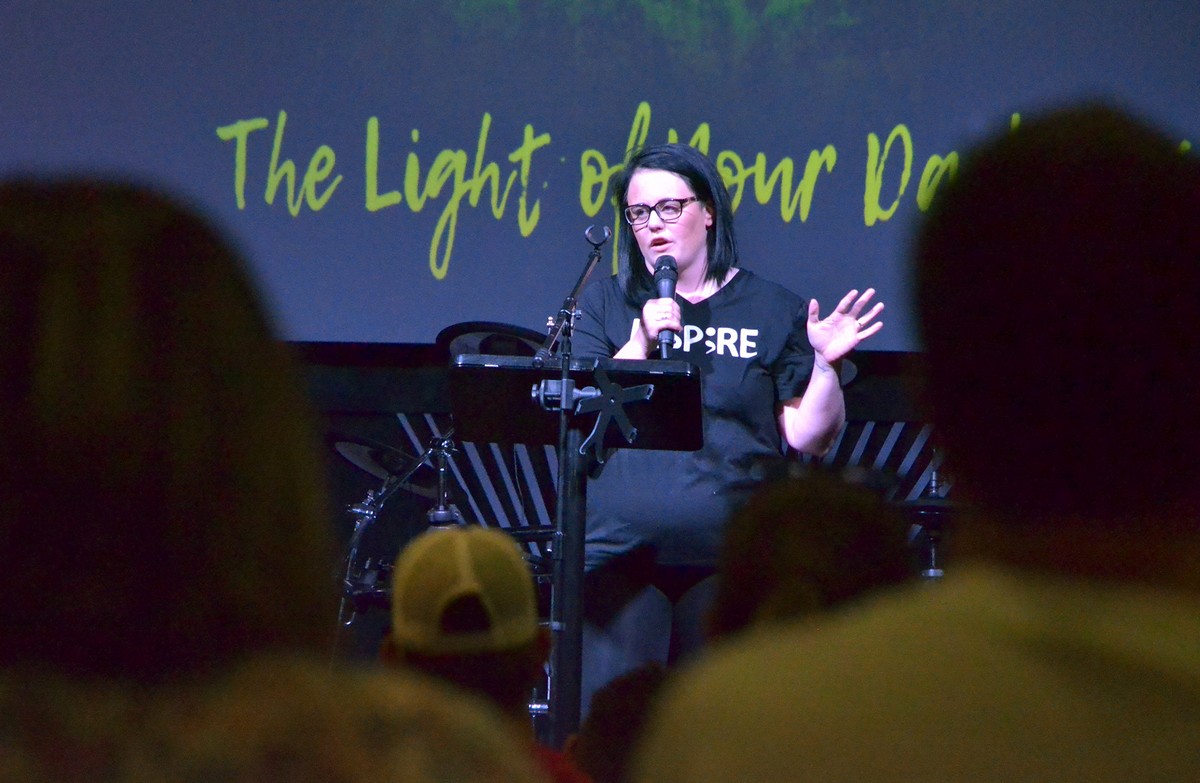
Ashley Metzger talks about experiencing feelings of anxiety, depression and sadness during ‘The Light of Your Darkness’ event on Monday night at CenterPointe Church in Vandalia.