
St. Paul Lutheran Church celebrates 150th
In the mid-1850s, the Illinois Central Railroad had been granted 28 square miles in Fayette County for construction of its north-south line from Cairo to Chicago. Once construction was complete, they were to return any land to the state not needed to build the rail line. Instead, they put it up for sale.
Settlement in Wilberton Township up to this time was mainly on the watercourses, and at the edges of the forested land. The people were afraid of the prairie, and generally held the belief that since the land wouldn’t grow trees then it wouldn’t grow much of anything.
Advertising a million acres of land for sale in prices ranging from $8 to $12 an acre, the railroad offered free passage for anyone who wanted to look at it.
Michael Sasse of Dodge County, Wis., took them up on their offer and returned to Wisconsin with glowing accounts of the flat, well-watered land. Wisconsin offered to them backbreaking hours spent moving rocks and cutting trees from the solid forests, just to farm an acre.
Discord over the slavery issue in their Wisconsin church prompted the move, as did the more moderate climate. Throw in the difficulty in clearing the land for planting crops and the "grand prairie" of Illinois was looking better all the time.
The Wisconsin families – Sasse, Oertwig, Schukar and Fellwock – were all inter-related, having migrated from Nahausen, Germany, in 1846 seeking religious freedom.
The families of Gottfried Stein, Robert Maske, Friedrich Malchow, John Frederick Fellwock, Ferdinand Busse and Ludwig Lenz were also counted among the 12 families who followed Michael Sasse to Illinois.
The first services were held in the home of John Frederick Malchow, whose cabin in Section 22 of Wilberton Township, was .25 mile northwest from the current site of the church.
In the autumn of 1865, the group purchased the improvement of one of its members who had returned to Wisconsin. Oxen were employed to move the structure two miles north to the current site, where the church had bought 40 acres of land.
Pastor Johann W. Streckfuss of the Lutheran Church of Grand Prairie of Okawville in Washington County, Illinois, would occasionally preach and administer the sacraments to the small congregation. In 1867, the St. Paul congregation joined the Missouri Synod, and on June 18, the Rev. Gottfried Endres was installed as their first resident pastor.
At this time the congregation was comprised of 250 people, including 91 voting members and 76 children who were attending a church-sponsored school.
Carl G. Schuricht, pastor to a small group of Lutherans in Vandalia, was the next minister to guide the St. Paul congregation. Referred to as "the sainted Pastor Schuricht,” he was well loved by his St. Paul people, and membership doubled under his charge.
His brother, Herman Schuricht, was hired as a school teacher, and he, too, served the church long and faithfully. By the 1870s, there were three schools for the settlement’s children – one at St. Paul, the "east" school and the "west" school.
In 1879, after 15 years of steady growth, the congregation outgrew its original house of worship and decided to build its first sanctuary, pictured above. The building specifications called for a 110-foot spire, (steeple), with three main girders supporting the roof.
On June 29, 1879, the cornerstone was laid for the church. The first building had separate doors for the men and women, with the estimated cost of $4,500, with a majority of the labor being donated by parishioners.
Lightning struck the steeple on July 28, 1914, and the church burned to the ground. On May 9 of the following year, the cornerstone for the current church was set in place and construction began. The new church was dedicated four months later.
This year, the St. Paul congregation celebrates the 150th anniversary of its founding. The first special service will be held on April 6, with David Knecht of East Lansing, Mich., engaged as the speaker at the dinner at the parish hall.
At 2 p.m., the church bell will be rung, calling all to a special afternoon worship service in the church, just as it has called its people to worship for well over 100 years.
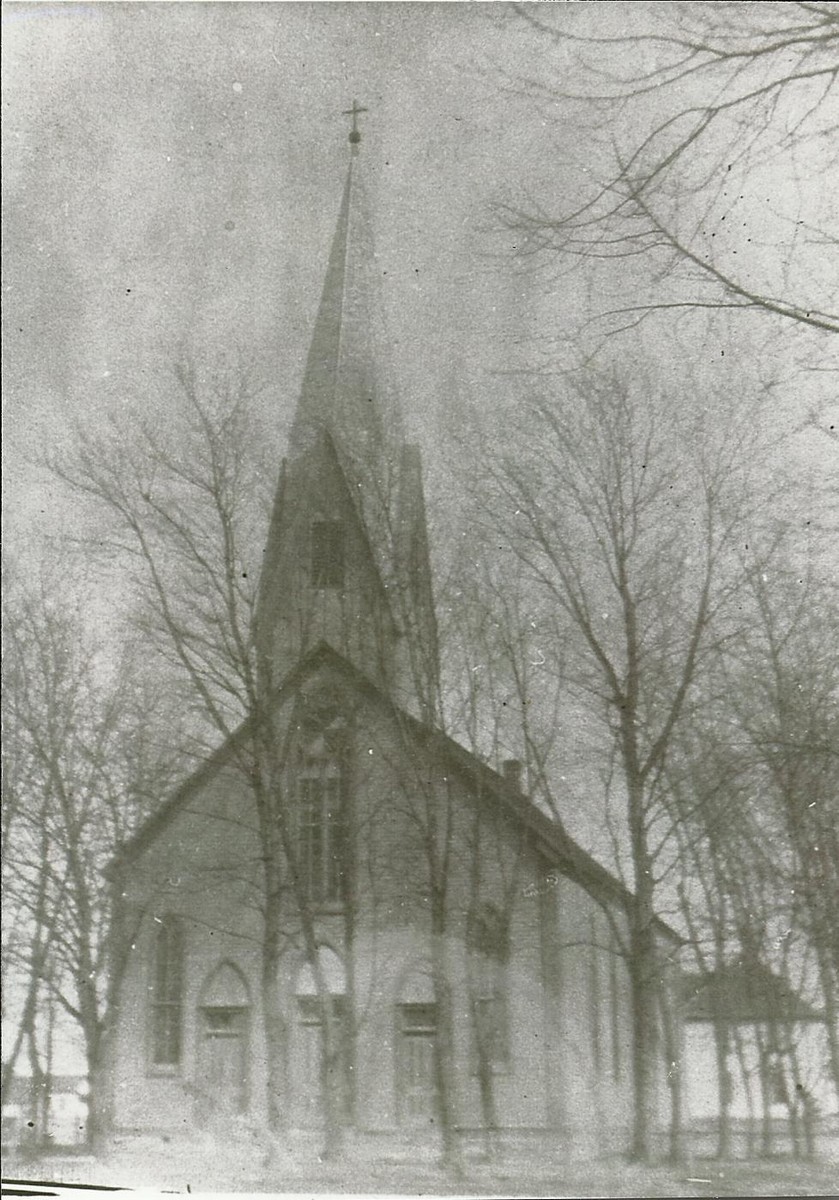
The first building to house St. Paul Lutheran Church was built in 1879 at a cost of $4,500. It featured a steeple that rose 110 feet into the air. The original building was struck by lightning and burned to the ground.