
Vandalia had many inns and taverns
In my spare time during the past several years, I have been working on a project to identify as many of Vandalia’s early taverns as I can. In those early days, a tavern was where you could find a place to sleep, and an inn, or grocery, was where you would find a dram of whiskey.
Capital-era Vandalia fascinates me. The story of the Ernst Colony, the people who made Vandalia home during the capitol years and the stories of the first settlers are all interesting subjects to me.
Paul Stroble completed a great deal of newspaper research while working on his book, “High on the Okaw’s Western Bank,” published in 1992, and it is from this that I drew some of my information. In 1986, he submitted an article titled, “Businesses and Establishments in Vandalia 1819-1840” for publication in Fayette Facts, the genealogical publication of the county genealogical and historical society.
Studying ads and legal notices, Paul documented names of many taverns and their keepers, along with the location. He named Charles Reavis as having the first known tavern in Vandalia, occupying the southeast corner of Fifth and Johnson streets near the first capitol building.
In the fall of 1819, Friedrich Hollman completed the two-story log Union Hall, which stood east of the current statehouse. Hollman had been instructed by Ferdinand Ernst to prepare homes for the nearly 100 Hanover emigrants that he would bring to Vandalia, and Hollman, aware that the state legislators moving from Kaskaskia to Vandalia would need a place to lodge, erected this 24-foot-by-36-foot building first.
It proved to be a smart move, for when the legislators arrived in Vandalia, they had expected that they would have to push on to the home of John Tillson near Hillsboro to find a place to board.
Among Vandalia’s first taverns were Traveller’s Hall, built by Daniel Bathrick and licensed in October 1820, and the Eagle Tavern, established in 1821.
John Baugh kept a double log cabin boarding house very early, and in 1822, E.M. Townsend advertised that his tavern had 13 lodging rooms and a 44-foot-by-20-foot dining room. Townsend’s Tavern was located on the southeast corner of Kennedy and Gallatin streets as early as June 1822.
Several inns followed old English titles, such as Sign of the Bell, Sign of the Golden Eagle and Sign of George Washington (on the corner of Fifth and Johnson, which later became known as the Columbian Hotel). It was built by Thomas Cox, one of the commissioners, who chose Vandalia as the site of the new capital.
Lemuel Lee, who also built the first mill on the Kaskaskia River at Vandalia, operated the Sign of the Globe on Gallatin Street between Third and Fourth streets, and Abraham Lincoln boarded there. Some of Vandalia’s Lincoln stories were told by the Lee children.
Lincoln also stayed at the John Charters’ Hotel, the building standing into the 1920s, and in a rooming house that stood at 615 W. Johnson Street.
Redmond’s Sign of the Green Tree at Fourth and Main streets, along with the Charter’s Hotel, Hollman’s two-story log Union Hall to the right of the capitol and McLaughlin’s National Tavern, directly behind the capitol, are depicted in the Vandalia mural painted by artist John Matthew Heller of St. Louis.
The Flack House stood where Allen’s Furniture Store does today, and Mathew Duncan’s Hotel was directly across the street, at the site now occupied by a building erected in 1868 and home to Something Special Florist.
Heller’s mural, which measured 8 feet by 17 feet, was commissioned by Charles A. Evans, using research from Joseph Burtschi, and was dedicated in October 1954, in the dining room of Hotel Evans. It was lost in the March 3, 1969, fire that destroyed the five-story hotel.
For those who desire to see what the original painting represented, Vandalia artist Lorraine White has re-created the Heller mural in the Fayette County Museum. Here, visitors can see an accurate depiction of the Vandalia that Lincoln would have seen when he served here as a member of the legislature.
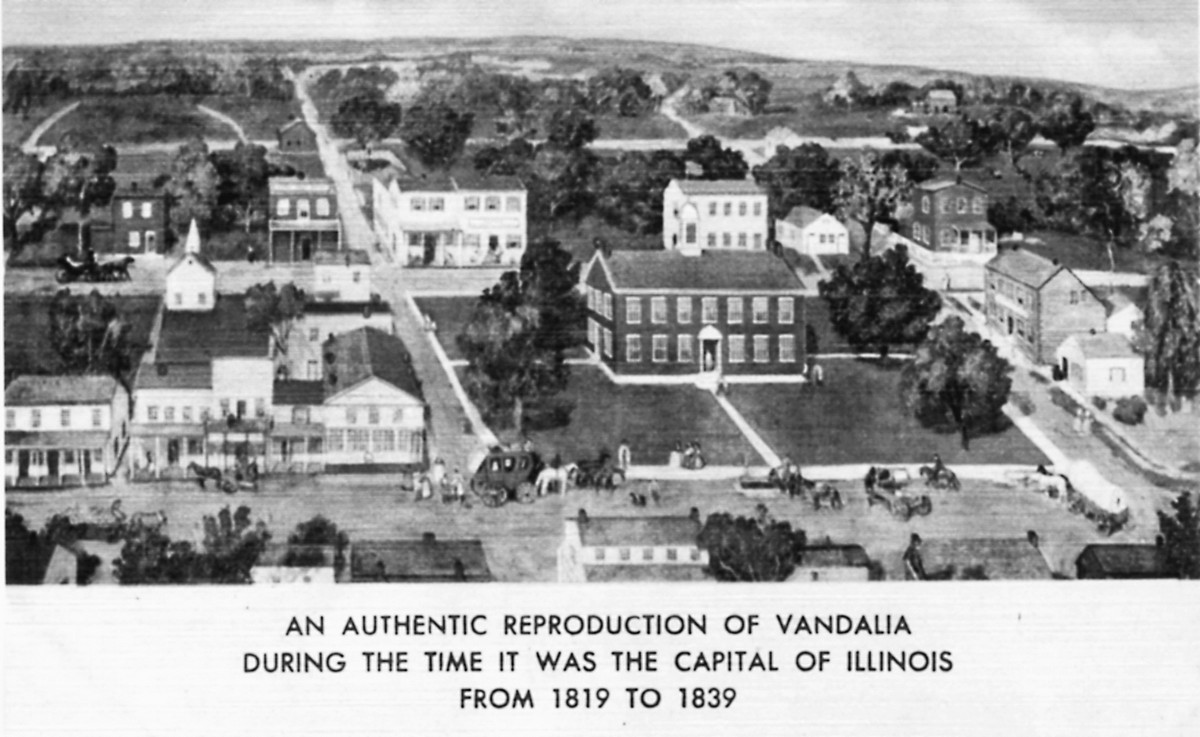
This mural, painted by St. Louis artist John Heller, was commissioned by Charles A. Evans and dedicated in 1954. It measured 17 feet by 8 feet, and was displayed in Hotel Evans.