
‘French 500’ had connection in Fayette
One of the “perks” of being involved in history and historical research is that, from time to time, I am contacted by people with fascinating stories about their Fayette County family.
The late Lane Trueblood of Glen Ellyn was one of those. Over the years, Lane and I had shared photographs and obituaries from the Spires family of Ramsey Township. One day, he mentioned another of his Fayette County families that, indeed, had an interesting story.
Thomas Francis Barker, who lived in Sefton Township, was Lane’s great-great-grandfather. Lane told me, “This man has a connection to an almost-forgotten segment of American history. Thomas Barker’s great-grandfather was a member of the "French 500" of Gallipolis, Ohio.
The man he was referring to was Philip Augustus Pithoud. Born in France in 1770, Philip Pithoud had training as a jeweler, and when the French Revolution first began, had already entertained thoughts of emigrating to America.
While all the unrest, caused by the French Revolution, was going on there, in America, Congressman William Duer and his associates, who had formed a private venture called the Scioto Co., were asking Congress for a land grant of 3.5 million acres in Southern Ohio.
In 1789, Duer sent a salesman to Europe to sell the lands, setting up an agent in Paris. The prospectus told that the land teemed with wild game, delicious vegetation and every type of precious mineral could be found – all in weather so mild that frost was unknown.
Five hundred people, including noblemen, professionals, artisans and Philip Augustus Pithoud, became owners of land in far-away America. They set sail in seven ships for their new homes in January 1790, landing at Alexandria, Va., five months later.
Upon arrival, the French learned that the Scioto Co. had failed to meet its contract with Congress, and the land they had paid for was not theirs. The money was gone.
The defrauded landowners turned to the public for assistance in 1795, and because the French had been a great help during the American Revolution, their appeals were heard. The Ohio Company of Associates, another land speculation company, came forward and offered to let the French settle on their land.
The land company sent Maj. John Burahan, along with a group of 36 New England craftsmen, to the site of the new settlement in Southeastern Ohio, in the fall of 1796. It took a month to build four blockhouses and 96 log cabins, all clustered around a central square. The settlement later became known as “City of the Gauls” or Gallipolis.
Many of the "French 500," including Philip Pithoud, moved to the Ohio lands, while others sold their land grant and moved on. It was said that the French had poor survival skills; and with the constant fear of Indian attack, it wasn’t long before many of the families left the Gallipolis settlement.
Gallipolis gradually became a thriving trading center, and Philip Pithoud raised crops and produced peach brandy from the fruit of the many wild orchards. As with other French settlements, Gallioplis became renowned for their many celebrations, and that was good for Philip’s business.
He expanded his business to another French settlement, New Orleans.
By 1807, only 20 of the original families remained. Philip Pithoud died in 1803, and his wife, Nancy Watts Pithoud, whom he had met on the trip to Ohio, continued to live in the village. They were parents of three children, including sons John and Francis.
John and Francis Pithoud grew to adulthood in Ohio, and it was here that Francis married Catherine Moore. In 1828, Francis Pithoud and his family, along with mother, Nancy, migrated by covered wagon to Parke County, Ind.
It is through Francis’ daughter, Susannah Pithoud Barker, that the connection to Fayette County is made. Susannah and her husband, William Barker, lived out their lives in Indiana. Their second son, Thomas Francis Barker, grew to manhood in Parke County, Ind., and married Emily Morgan there in 1869.
Emily died in 1883, and it was about this time that Thomas learned of the Illinois Central Railroad land sales in Central Illinois. Thomas came to Illinois to investigate, and purchased land on White Oak Mound in Sefton Township.
He remarried in Fayette County on Aug. 5, 1883, to Emma Deaton, and they were parents of six children. Lane Trueblood’s grandmother, Jenny Barker, was 14 years old when her father, Thomas, died in 1902. Emma raised her children and later remarried.
Lane wrote that “many descendents of Thomas and Emma Barker still live in Sefton Township, largely unaware of a long-ago connection with Revolutionary France and the 'French 500.'”
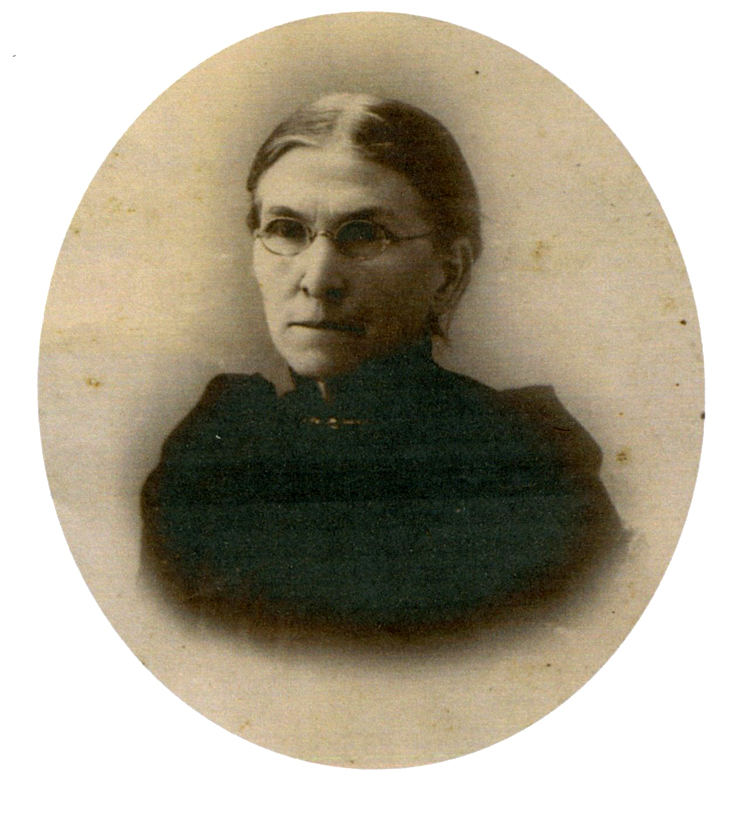
Susannah Pithoud Barker, above, was Thomas Barker’s mother.