Getting their heads together
The only National Road Interpretive Center in Illinois moved one step closer to completion on Monday, with the unveiling of busts of four men who were instrumental in the construction of the only federally funded and federally built highway in the nation.
With the help of Joyce Mueller and Jesse Maas, two volunteers at Vandalia’s interpretive center, National Road Association of Illinois Vice President Jerry Swarm, also of Vandalia, unveiled the busts of George Washington, Thomas Jefferson, Henry Clay and Albert Gallatin.
The busts were created by Justin Poole, an Ohio sculptor, who was selected through a bidding process for the project. The busts were among the projects that are being funded through a National Scenic Byways Program grant of more than $100,000.
“These are four important figures in the history of the National Road,” said John Goldsmith, National Road Association of Illinois executive director.
In introducing the artist and his partner, Laura Davis, Goldsmith said of the busts, “I consider these to be of museum quality.”
Poole conceded that as he was chosen for the project, he knew nothing about the National Road. But he and Davis quickly learned about the road, doing much of their research by using the Internet.
He explained what he wanted the final products to look like.
“We wanted the sculptures to look like 19th century paintings,” Poole said.
“These really should look the way we know these people, and the way we know them is through paintings. I wanted them to look like paintings from that period, so that’s why they have a certain sort of petina.”
Poole also knew going in what he didn’t want the busts to look like.
“I really didn’t want them to be a hyper-realistic wax museum look, because I find that that’s weird,” he said.
The busts, Poole said, “have a slightly idealized 19th century (look) that we’re used to seeing them portrayed as.
“I wanted something that was dignified and elegant, period-correct in their feeling and look.”
Davis said that as she and Poole researched the four men, “We tried looking up information, and it was hard to find.”
That was the case, she said, until she decided to drive from Ohio from Vandalia to visit the local interpretive center, which is located at 106 S. Fifth St. “You guys had the best source,” Davis said.
Also, “Wikipedia was very informative,” she said.
However, Davis said, “We still couldn’t figure out, why Gallatin?”
Poole added, “And Gallatin, to some degree, is the most important of the four. He’s the least-known, but the most-important in creating the National Road.”
Gallatin, Jefferson’s secretary of the treasury, “hatched the concept of a national road in 1802 … and championed the project by securing funding through the sale of western public lands to settlers,” according to the National Road Association of Illinois website.
Washington was in charge of the Braddock Road, which later became the National Road, and Jefferson authorized the construction of the National Road.
In 1840, when Congress voted to end construction of the road, Clay cast the deciding vote. Vandalia is the western terminus of the road.
Poole described the process of creating the busts.
“You get a big pile of clay, and you push it around,” he said, drawing a laugh from the crowd of about 30 people on hand for the unveiling.
“Actually, it’s not that far off,” he said.
“I have a background in classical sculpture, and I do a lot of portraits, and I do mannequins and some wax figure work and other museum work.
“We found as many photographs as we possibly could, getting as many angles (of the men) as we could,” he said.
Poole said the busts have “20-25 coats of different coats of paint on them, layer after layer, to give that burnt umber glazing, to give them that mellow, aged look.”
The sculptor said he considered it “a huge honor … to be a part of this project.
“It was great to feel connected to the country and its history … and I had great fun doing it,” Poole said.
Goldsmith said the completion of the busts is one of the important steps in creating a comprehensive interpretive center.
“This is a work in progress, but we are very close,” he said. “We can see daylight at the end of the tunnel.”
Among the other projects being funded with the federal grant, Goldsmith said, is an interactive map, which he said should be completed by late summer or early fall.
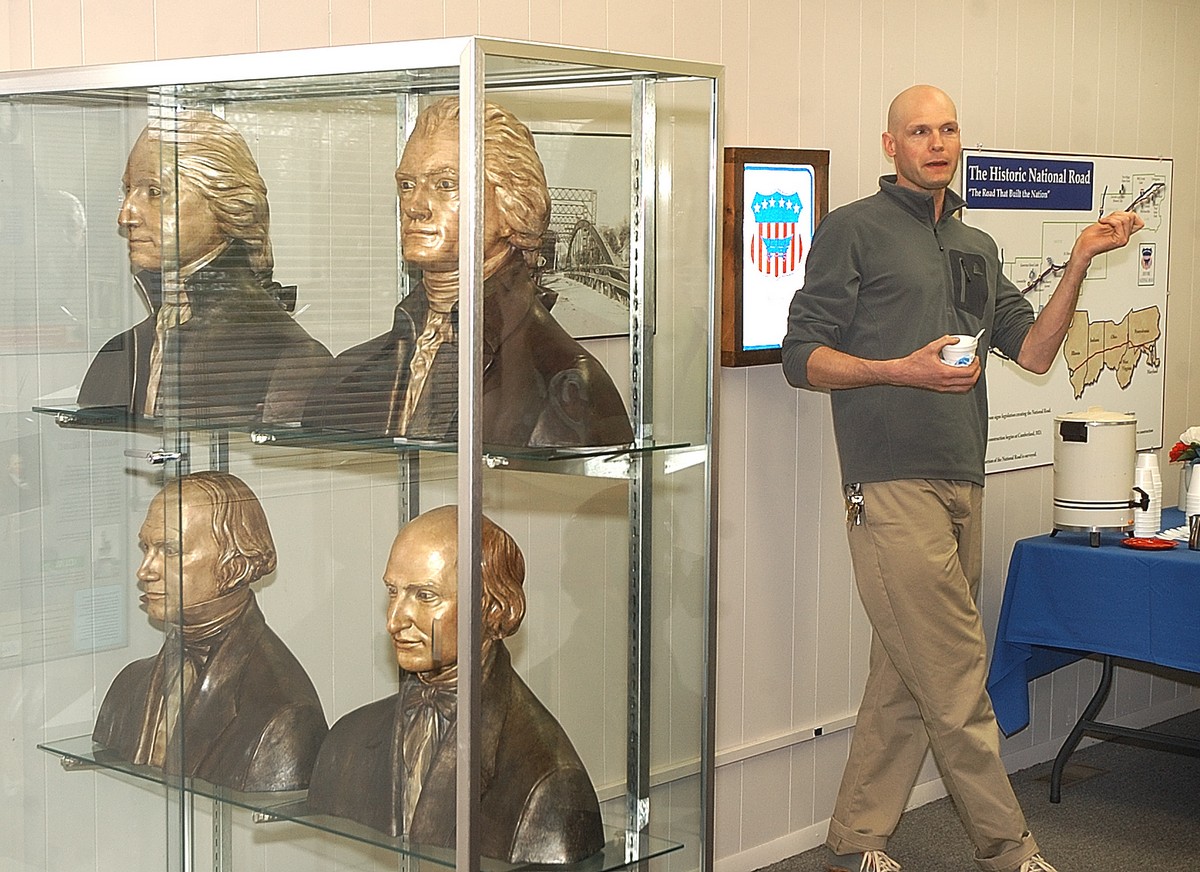
Justin Poole, the Ohio artist who sculpted the busts of four men who played key roles in the construction of the National Road, talks about his approach to the project after the busts were unveiled at the National Road Interpretive Center in Vandalia on Monday morning. The busts of George Washington (left) and Thomas Jefferson (right) are on the top shelf, and below them are busts of Henry Clay (left) and Albert Gallatin (right).

Joyce Mueller (left) and Jessie Maas, two volunteers at the National Road Interpretive Center in Vandalia, help Jerry Swarm, vice president of the National Road Association of Illinois, unveil the busts of George Washington, Thomas Jefferson, Henry Clay and Albert Gallatin during a ceremony at the center on Monday morning.