COMING SOON TO A NEIGHBORHOOD NEAR YOU….
 By Deb Simcox
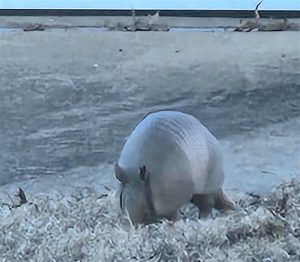
What is that? Where did it come from? Are there others? A sighting last week and pictures brought into the Leader Union office by Judy Hulskotter revealed that at least one armadillo has made its way north to Vandalia. Within the past few years, an armadillo sighting was reported in Patoka, but this is believed to be the first in Vandalia.
Armadillos are mammals that usually favor tropical climates and are the official state animal of Texas. They are believed to have originated in South America, descending from glyptodons, which diverged 35 million years ago. They continue to favor warmer weather. Of the 20 species of armadillo, only the nine-banded armadillo has been migrating north since the mid-19th century.
According to National Geographic, armadillos, which are omnivores, feed on plants, some fruit, grubs, worms, and occasionally road-kill. They have poor eyesight but keen smell, strong legs, large front claws for digging, and long sticky tongues for pulling termites and ants from their tunnels. They are generally shy animals and nocturnal, sleeping up to 16 hours a day in their burrows. They are generally solitary animals but do band together in their burrows for heat.
Nine-banded armadillos usually produce four offspring, from a single egg, which divides into four identical embryos. The gestation period is two to five months. These babies become independent at around 10 months old. Their lifespan is four to 30 years. Their “armor” is a shell of hardened skin or plates of dermal bone (scrutes or osteoderms), which helps protect against its natural enemies. Unfortunately, it is no protection against motorists.
Fayette County Animal Control Administrator and Warden Loralyn Valencia reported that she had never seen a live armadillo in Vandalia before. Animal Control does not remove wildlife and recommends that if a resident is troubled by an armadillo, to call IDNR (Illinois Department of Natural Resources). Otherwise, she said to just avoid the armadillo.
So drive slowly, motorists, when seeing these critters because they are not speedy enough to get out of your way.